On Working Identity by Herminia Ibarra, and where this place got its name
For the life of me, I can’t recall how I first came across Herminia Ibarra’s work. What I distinctly remember is that I spent a whole day reading and listening to every interview of hers I could find. By the evening, I knew I had to have her book.
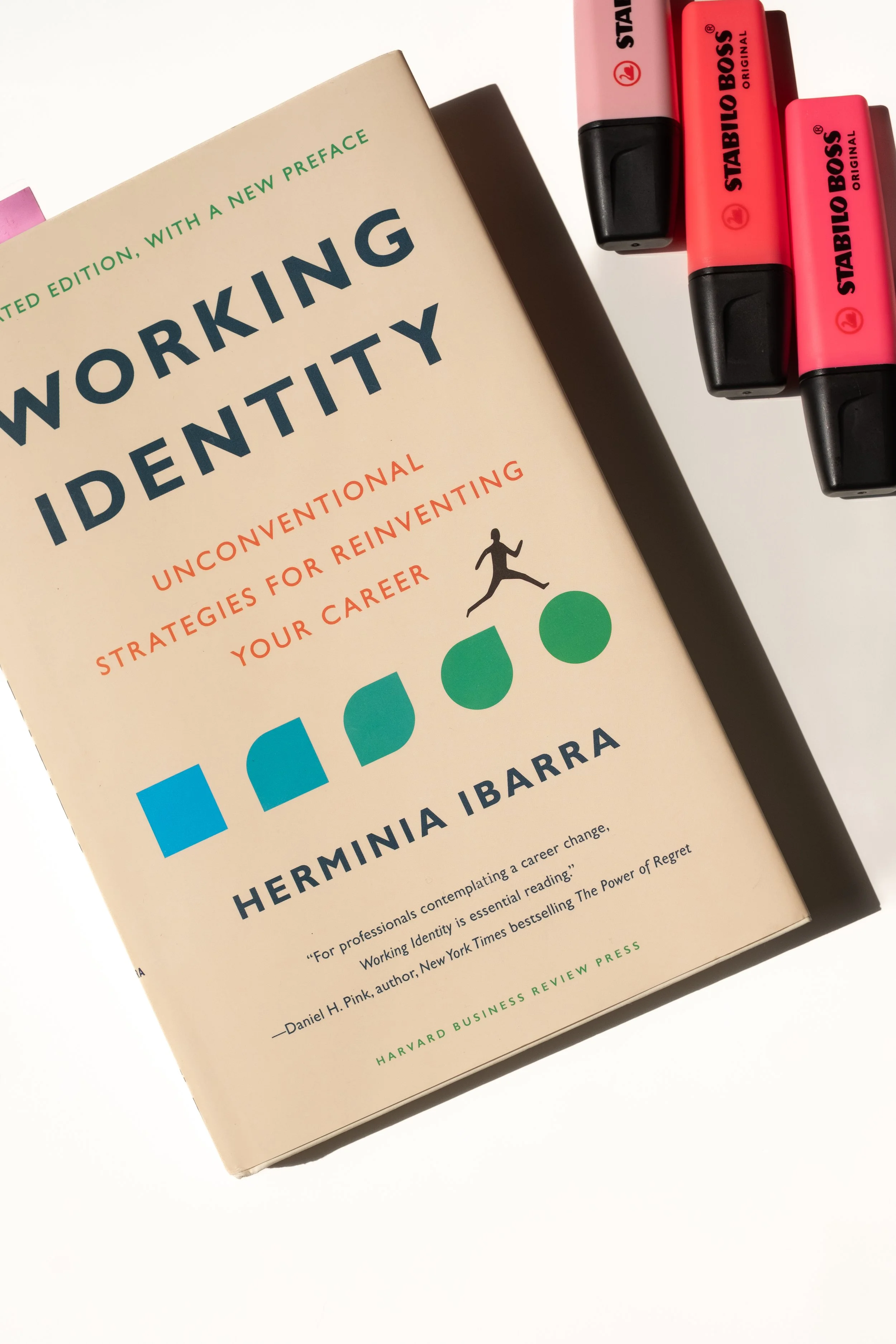
The next day, 15 March 2024, I accompanied a friend to her television interview, for moral support. It was nine months after closing the company I had spent a decade building.
From there, I went looking for the book in a bookstore I had never set foot in before. The only copy was nestled so far out of sight that I had to ask for help to find it. I like to think it was waiting for me.
At that point in my life, I was re-evaluating everything, not just my career. I was standing at an intersection with no road signs, and two questions followed me everywhere: what next, and what do I really want to do?
I take self-help books with a pinch of salt; few stand the test of time, so I pick them up less and less. To be clear, this book does not belong on that shelf. Herminia Ibarra is currently Professor of Organisational Behaviour at London Business School, having previously taught at Harvard Business School and INSEAD, and Thinkers50 ranks her among the world’s top management thinkers.
In short, Working Identity is two hundred concise pages on how people actually reinvent their working lives, grounded in academic research and field-tested in real careers. It helps you ask the questions that matter, and see where you stand and where you could be heading. Its central idea is as simple as it is counterintuitive: you cannot think your way into a new career. You have to act your way into it.
I knew it would have to be an active read, the kind I do armed with post-its, highlighters and legal pads (more on my active reading method in a future piece). I dove in, and something instantly clicked. I felt seen, and for the first time, my way of questioning made sense. My gut feeling had found its evidence, and my doubts a path to follow.
Inside Out
Closing the business felt liberating, and dizzying at the same time. I could open any door. But which one should be next?
Those two questions never left me: What next? What do I really want to do? They were there in the morning and still there at night, in every quiet moment without a meaningful professional project to hide behind. My home had never been so impeccable, yet I could not write a résumé that captured what I wanted to do.
Uncertainty and doubt are part of being human; we all meet them. What surprised me was how little exists to help us navigate them in the one area that takes up most of our waking hours, and so much of who we think we are. Careers come with an oversimplified blueprint: study, work, climb, retire. Transitions are the part we rarely share, and when we do, it is without the granularity or the raw honesty they deserve. We tell the before and the after, never the messy middle. Yet that is exactly where you need more than generic advice. You need guidelines, almost a proof of concept: evidence that others have crossed these murky waters before you, and how. Some find their way eventually, but alone, and the hard way. Not everyone does. Ibarra puts it plainly: when it comes to finding work that matters, “we’re mostly on our own.”
The advice that does exist tends to start with the classic Human Resources questions. What are your strengths? Your weaknesses? Where do you see yourself in five years? It felt like déjà vu. I was eighteen again, being asked what I wanted to do with my life, and finding it just as hard to answer. How do you describe a destination you have never been to? The only difference now was experience. The questions, and the methods, were essentially the same. They ask you to find the answer in your head before you have put anything to the test. Ibarra’s research suggests that is precisely the wrong way round.
Outside In
As if self-doubt were not enough, questions crept in from the outside too, and they are still among the hardest to navigate.
I naively believed my inner life was rich enough not to be defined by my work. I have always said that being a CEO does not mean a thing. In Singapore, it takes S$315 and an online form to become one.
What confused me was the reflection the outside world sent back. It had intertwined me with the industry and the title. Ibarra warns that this kind of “overidentification with any institution can lead to stunted growth in other arenas.” Reading that, I realised the label I claimed not to wear had stuck.
When I closed the business, people thought I had left town. In social settings, I could see close friends hesitate over how to introduce me, beyond my name. Not that I need a title to be introduced. The discomfort was understandable, and palpable.
It was a quiet kind of erasure. I had closed a business, not disappeared. I was still me. Or was I?
Then there was the question at every social gathering: what do you do? Or: what industry are you in? As a third culture kid, married to another and raising one, I already dread where are you from? and its close cousin, where is home? Both ask for a single answer when the truth is plural. Now a third question had joined them.
As a marketer, I was trained to have sharp positioning and an elevator pitch to match. A confused mind never buys: if people can’t place you, they can’t refer you, and they can’t help you. In transition, there is either no answer or a multitude of them. So I did my best to dodge the question, or defuse it.
Ibarra calls it the ought self: the person others believe we should be. I felt trapped in the version of me they saw, as if changing direction would disappoint them, and refusing to fit it would label me as difficult.
I am not one to share much with my inner circle until something is done. But in the early days, I did start to share the directions I wanted to take, hoping they would brainstorm with me, or at least humour me. Their reactions stopped me in my tracks most of the time. One step forward, two steps back. The book made me see that while an idea is still forming, your closest circle is rarely the right audience for it, which is only natural. I was pitching an unfinished product to the wrong target audience. Ibarra draws on sociologist Mark Granovetter’s famous “strength of weak ties” study: most people find their jobs through personal connections, and those connections are rarely friends, family or close colleagues. They are distant acquaintances. So I started talking to people outside my circle.
Halfway Along No Path
For months I lived entre deux, and in some ways I still do: in between, without knowing what the other side is. Halfway along a path, without knowing where the path leads.
The book gave that place a name: liminality, “the hallmark of transition.” Ibarra describes a psychological zone in which we are “truly between selves, with one foot still firmly planted in the old world and the other making tentative steps toward an as-yet undefined new world.” The in-between is not a delay before the real thing. It is a tumultuous stage in itself, a universal one, with its own set of rules.
The prognosis that helped me most: a coherent story only exists in hindsight. You cannot tell it sharply until you have lived it, so the blur in the meantime is a rite of passage. And if your answer changes each time someone asks, remember: you are rehearsing.
Grasping that concept gave me the courage for a bigger leap: documenting it all, here, as it happens.
Flirting With Possible Selves
You don’t find your next self through introspection, and you don’t wait for clarity before you start. Clarity comes from doing: small experiments, trial and error, testing possible selves in real life rather than in your head. Ibarra’s advice is to go out and “flirt with many possibilities.” So I did.
My notes from that first read were where my experiments began.
One note was about the glimpses in my career when I felt most in the zone: exhilarated, and at the same time completely at ease. It was never when I simply recited what I knew. It was when I asked the questions that helped others reach their own answers, the Socratic way.
I was not the one who noticed the effect it had. The people who reached out after a talk did. Looking back, the first sign came twenty-five years ago, at my first presentation at business school. The jury of professors was distracted, barely listening, until I started speaking. Then they looked up. Ibarra encourages us to get “back in touch with forgotten selves”, the early interests and strengths that tend to resurface once we start looking.
Then a friend of my brother’s, whom I had not seen in years, came to visit and asked about my plans. I answered vaguely. He listened, and summed it up in a few words: la transmission du savoir, the passing on of knowledge. For some reason, said in French, it just gelled. It hit me: yes, that is it. A dormant tie, as Ibarra calls it: someone you were once close to but have not seen in years, whose perspective can be worth more than that of your everyday circle.
So I looked around me, found an opportunity to test it, and started teaching.
Not every experiment sticks, and that is part of the process. You discover what you are, but also what you are not, and you let go of some possible selves along the way. That is both liberating and powerful.
It works much like the lean startup method used in business: test, learn, adjust. With one caveat. When a test goes badly, the old self is always there, and it is comfortable. It will even come looking for you, with offers to slip back into your old role, your old industry, your old title. Steer away from them. That is easier said than done: when you need an income, nois a very hard word to say. But don’t move back in simply because you know where everything is.
In the end, the only real risk is standing still. Ibarra heard great regret only from those who failed to act. In her words: “The only wrong move consisted of no move.”
Where the Name Came From
Teaching took care of the classroom. But there was knowledge I also wanted to share beyond the professional realm, the kind no classroom teaches. I wanted to start by going back to my solace, writing. And I needed a name for it.
Then a simple sentence seemed to engrave itself in my mind: “The important transitions in our lives have had a script.” It did more than crystallise a hunch I already had. One word in it would not let me go: script.
With Working Identity, Ibarra had given career transitions the closest thing to a script I had found. I wanted to be the scribe for the ones still missing: on identity, health, reinvention, and the seasons nobody prepares us for. I explained why in the very first piece here, The Script I Wish Someone Had Given Me.
So I gave myself a challenge, a way to flirt with a possible self of my own: a number of articles and interviews, learning in the open. If an article does not land, or an interview request gets a no, it is still a victory. I learn, and I adjust.
Working Identity is the only book I have read twice; life usually feels too short to reread anything. It is not a step-by-step method, and it makes no promises. Much of it feels like common sense, though common sense is harder to define than it sounds. It asks for some introspection, far more action, and constant readjustment. It is a companion for every turning point, written by someone who seems to know exactly when your doubt will creep in, and answers it on the next page. At this point, I should simply order a carton and hand them out.
Who is it for? Some see it as a book for seasoned professionals and business school classrooms, and I understand why: many of its case studies follow people well into their careers. But I would hand it to almost anyone. The graduate choosing a first path. The parent returning to work. The founder closing a chapter. The executive quietly wondering what else there is. For those just starting out, it offers something rare: permission to test before committing, and to expect the path to change.
I am still doing the work myself. I am designing a portfolio career built on five pillars, and testing each of them. Along the way, I have come to believe that all of us, to some extent, should be leading a portfolio life: never fully defined by one title, one company or one industry. It may also be the most honest answer I have found to what do you do? I still get the looks. But I now know it is not because something is fundamentally wrong with me.
The story might change. Marketers forget that the best stories are often the ones built in hindsight. Or, as Steve Jobs put it: “You can’t connect the dots looking forward; you can only connect them looking backwards.”
Whether you are content where you are, standing at your own intersection, or just starting out, this is a script you will come back to again and again. Read it with a pen.
Nejla
P.S. If it clicks for you too, Ibarra’s next book, The Bonus Years: Reinventing Our Longer Work Lives, arrives in January. Mine is already pre-ordered.
“As you start to walk on the way, the way appears.”
Where to find it
Working Identity by Herminia Ibarra is available at Kinokuniya, Amazon and your local bookstore. The Bonus Years is available to pre-order now, ahead of its release on 12 January 2027.